
When Recycled Content Mandates Break Chemical Recycling: Why Polymer-Agnostic Laws Contaminate MLP Feedstock
A Policy Paradox Threatening Chemical Recycling
The global push for circular plastics has produced an unintended consequence that threatens the very infrastructure it seeks to support. Recycled content mandates — legislation requiring manufacturers to incorporate post-consumer recycled (PCR) material into new packaging — are among the most powerful policy tools for driving circularity. However, when these mandates are designed without polymer-specificity, they create a compliance trap that contaminates the feedstock pipeline for pyrolysis and other chemical recycling technologies.
The mechanism is consistent across affected jurisdictions: polymer-agnostic recycled content targets, combined with restricted availability of food-grade recycled polyolefins (recycled PE and PP), push manufacturers toward recycled PET (rPET) — the only widely available food-contact-approved recycled polymer — as a compliance material in polyolefin-based multi-layered packaging (MLP). The resulting PET-polyolefin hybrid structures violate every established Design for Recycling guideline and produce pyrolysis oils with oxygen contamination levels 40-800x beyond acceptable limits for steam cracker feedstock.
This article traces the complete causal chain — from legislation to packaging design to pyrolysis oil contamination — and compares regulatory frameworks across India, the UK, the EU, South Korea, and Japan to demonstrate that this is a solvable policy design problem.
Why Polyolefins Are Irreplaceable in Multi-Layered Packaging
Before examining the legislative failures, it is essential to understand why polyethylene (PE) and polypropylene (PP) are structurally non-negotiable in MLP design.
Multi-layered flexible packaging for FMCG products — snack pouches, sachets, flow-wraps, and stand-up pouches — relies on polyolefins for three critical functional properties:
Sealing properties: PE and PP provide the heat-seal layers that create hermetic closures on high-speed form-fill-seal machines. PET cannot replicate this function due to its significantly higher melting point (260 degrees C vs. 120-170 degrees C for PE/PP) and poor seal integrity at packaging line speeds.
Adhesive properties: In laminated MLP structures, polyolefin tie layers and adhesive layers bond dissimilar materials (metallised films, barrier layers, printed substrates). These inter-layer bonds depend on the low-melt flow and adhesion characteristics unique to modified PE and PP resins.
Flexibility and machinability: Large-format sachets and pouches require the puncture resistance, dart impact strength, and flexibility that polyolefin films provide. PET films are rigid and brittle in comparison, making them unsuitable as primary structural layers in flexible MLP formats.
PET serves a legitimate function in MLP as a thin, oriented outer layer providing printability and stiffness — but only when used in controlled quantities within a predominantly polyolefin structure. The problem arises when rPET is incorporated as bulk filler material to meet recycled content percentages, disrupting the polyolefin-dominant composition that pyrolysis and mechanical recycling systems are designed to process.
India’s EPR Framework: The Epicentre of the Conflict
The Legislative Structure
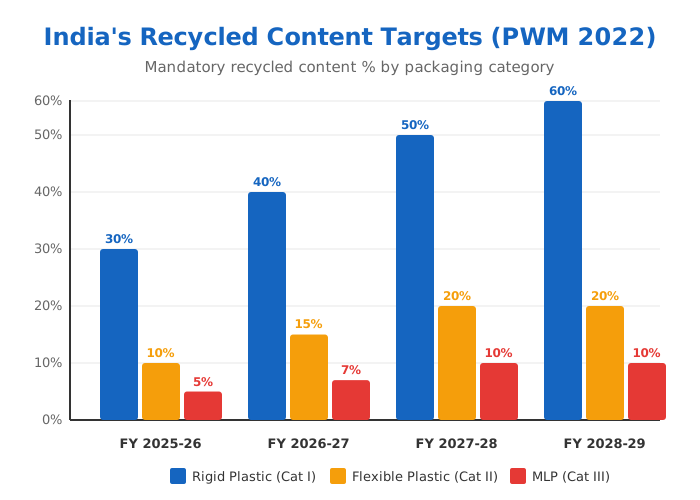
India’s Plastic Waste Management Amendment Rules (2022) mandate recycled content across all plastic packaging categories, with escalating targets through FY 2028-29:
Table 1: India’s mandatory recycled content targets under PWM Amendment Rules 2022, Schedule II
| Packaging Category | FY 2025-26 | FY 2026-27 | FY 2027-28 | FY 2028-29 |
|---|---|---|---|---|
| Category I — Rigid Plastic | 30% | 40% | 50% | 60% |
| Category II — Flexible Plastic (single/multi-layer polyolefin) | 10% | 15% | 20% | 20% |
| Category III — Multi-Layered Packaging (plastic + non-plastic) | 5% | 7% | 10% | 10% |
These targets are polymer-agnostic — the rules mandate a percentage of “recycled plastic” without specifying that recycled PE must be used in PE packaging or recycled PP in PP packaging.
The Compliance Trap
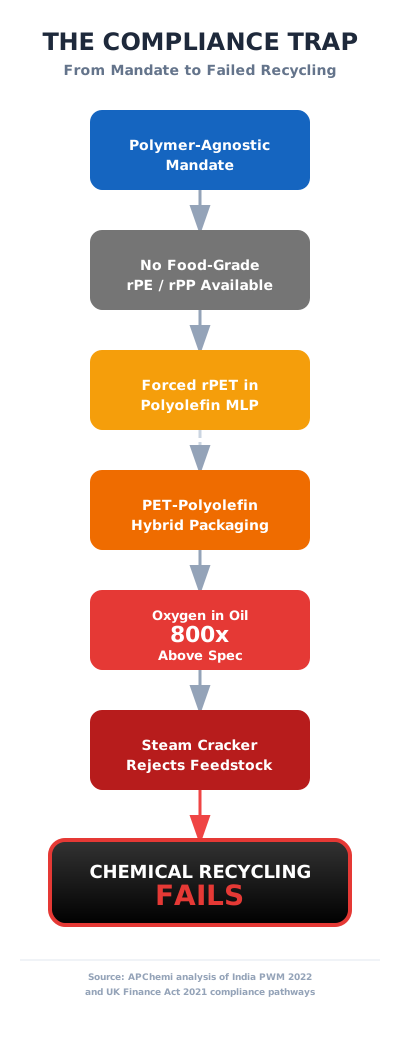
Three conditions converge to create the problem:
-
Only rPET is approved for food contact. India’s FSSAI approved recycled PET for food-contact applications through its March 2025 amendment, with five companies granted manufacturing approval as of September 2025. Recycled polyolefins (rPE, rPP) remain unapproved for direct food contact in India.
-
MLP is polyolefin-dependent. As established above, PE and PP are structurally irreplaceable in flexible MLP for their sealing, adhesive, and machinability properties.
-
Targets are polymer-agnostic. The legislation counts any “recycled plastic” toward the target, creating no regulatory distinction between using recycled PE in a PE structure (polymer-matched, recyclable) versus using rPET in a PE structure (cross-contaminated, non-recyclable).
The result: FMCG manufacturers needing to meet a 10-20% recycled content target in polyolefin-based flexible packaging have only one readily available food-grade recycled polymer — rPET. They incorporate it into PE/PP MLP structures, producing packaging that meets the letter of the recycled content mandate but violates every Design for Recycling guideline. FICCI has formally documented the shortage of food-grade recycled polyolefins as a major compliance barrier.
The Global Export Dimension
India is not merely creating a domestic waste problem. Approximately 23-25% of India’s FMCG production is exported globally. This means rPET-contaminated polyolefin MLP enters international waste streams — in Southeast Asia, the Middle East, Africa, Europe, and North America — where it will degrade the feedstock quality available to pyrolysis operators and chemical recyclers for decades. The contamination is structural and persistent: unlike a one-time spill, every year of production under polymer-agnostic mandates adds another layer of non-recyclable MLP into the global waste system.
The UK’s Plastic Packaging Tax: An Identical Structural Flaw
The UK’s Plastic Packaging Tax (PPT), enacted under the Finance Act 2021 and effective since April 2022, taxes all plastic packaging containing less than 30% recycled content at GBP 223.69/tonne (2025 rate). The British Plastics Federation (BPF) has explicitly identified why this creates the same compliance trap as India’s EPR.
The BPF position statement notes that due to current FSA legislation, mechanically recycled polyolefins cannot be used for direct food contact purposes, meaning a major part of the packaging industry has no source of material to incorporate in their packaging. This affects both rigid and flexible packaging. Additionally, the BPF has described the PPT as a blunt instrument that does not consider the technical or practical feasibility of using recycled content in each application.
Table 2: Structural comparison of India’s and the UK’s polymer-agnostic recycled content mandates
| Parameter | India (PWM 2022) | UK (Finance Act 2021) |
|---|---|---|
| Mechanism | Mandatory recycled content % by packaging category | Tax on packaging with <30% recycled content |
| Polymer specificity | None — “recycled plastic” | None — any recycled plastic counts |
| Food-grade recycled polyolefin approval | Not approved (FSSAI approves only rPET) | Not approved (FSA blocks mechanically recycled polyolefins) |
| Available compliance material | rPET only | rPET dominant |
| Flexible packaging recycling rate | ~5% | 7% |
| Consequence | rPET blended into polyolefin MLP | rPET channelled into polyolefin packaging |
The UK plans to accept chemically recycled plastic via mass balance methodology starting April 2027 to partially address this gap. WRAP has also launched a three-year project on “Advancing Food-Grade Recycling of Polyolefins,” explicitly acknowledging the need for recycled polyolefins in sensitive applications. However, these remedial measures are years away from producing material impact, while the contamination of flexible packaging waste streams is occurring now.
How Other Jurisdictions Avoid the Problem
Not all recycled content mandates are created equal. Several jurisdictions have adopted polymer-specific frameworks that prevent the cross-contamination paradox.
The EU’s PPWR: Polymer-Differentiated Targets
The EU’s Packaging and Packaging Waste Regulation (PPWR, Regulation 2025/40) contains a critical structural safeguard — polymer-differentiated recycled content targets:
Table 3: EU PPWR recycled content targets — polymer-differentiated by design
| Packaging Type | By 2030 | By 2040 |
|---|---|---|
| Contact-sensitive PET packaging | 30% recycled content | 50% recycled content |
| Contact-sensitive non-PET packaging (incl. polyolefin MLP) | 10% recycled content | 25-50% recycled content |
| Non-contact-sensitive packaging | 35% recycled content | 65% recycled content |
By setting a lower threshold for non-PET contact-sensitive packaging (10% vs. 30% for PET packaging), the PPWR reduces pressure to divert rPET into polyolefin structures. Additional safeguards include the EU Single-Use Plastics Directive, which creates strong pull demand for rPET in PET bottles (25% by 2025, 30% by 2030), channelling rPET toward its native recycling loop.
However, the EU is not fully immune. The 2040 escalation to 25-50% recycled content for non-PET contact-sensitive packaging will significantly increase pressure on recycled polyolefin supply. European supply bottlenecks for food-grade rPE/rPP are already anticipated, and the risk of cross-polymer contamination could materialise as targets escalate.
South Korea: Polymer-Matched Mandates
South Korea’s revised Enforcement Decree of the Resource Recycling Act (September 2025) mandates recycled content specifically within PET-to-PET closed loops:
- Phase 1 (2026): Producers using >5,000 tonnes of colourless PET bottles annually must incorporate at least 10% rPET.
- Phase 2 (2030): Threshold drops to >1,000 tonnes; rPET requirement rises to 30%.
By specifying rPET in PET bottles — not “recycled plastic” in any packaging — South Korea eliminates the incentive for cross-polymer contamination entirely.
Japan: Mono-Material Certification
Japan’s voluntary certification system under the Plastic Resource Recycling Promotion Act (effective January 2026) takes an even more prescriptive approach. Certified PET beverage bottles must be colourless, made entirely from PET, contain at least 15% recycled or biomass plastics, and feature PVC-free caps with easily removable labels. Household cosmetics containers must be mono-material PE or PP. The system is explicitly designed around mono-material Design for Recycling principles, making cross-polymer contamination structurally impossible under the certification framework.
Global Comparison
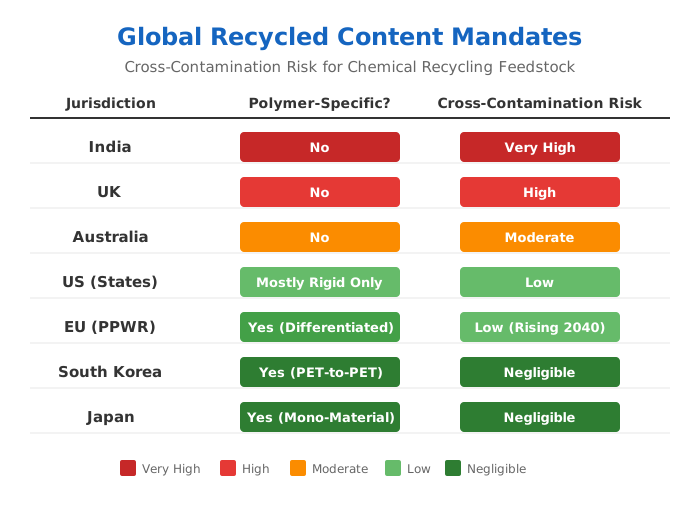
Table 4: Global comparison of recycled content mandates and cross-contamination risk
| Jurisdiction | Legislation | Polymer-Specific? | Cross-Contamination Risk |
|---|---|---|---|
| India | PWM Amendment Rules 2022 | No | Very High |
| UK | Plastic Packaging Tax (Finance Act 2021) | No | High |
| EU | PPWR (Regulation 2025/40) | Yes (differentiated targets) | Low (rising by 2040) |
| South Korea | Resource Recycling Act (2025 amendment) | Yes (rPET in PET only) | Negligible |
| Japan | Plastic Resource Recycling Promotion Act | Yes (mono-material certification) | Negligible |
| US (States) | Various (CA AB 793, WA SB 5022, NJ, CO) | Mostly rigid containers only | Low |
| Australia | Voluntary 50% target (transitioning mandatory) | No | Moderate |
The Chemistry: Why PET Destroys Polyolefin Pyrolysis
The technical evidence for why rPET in polyolefin MLP renders chemical recycling unviable is extensive and peer-reviewed.
Oxygen Contamination in Pyrolysis Oil
PET contains approximately 33 wt% oxygen in its terephthalic acid backbone. When co-pyrolysed with polyolefins at 400-600 degrees C, PET decomposes to produce benzoic acid (23.7-49.9 wt% of PET pyrolysis oil), terephthalic acid, carbon monoxide, carbon dioxide, and other oxygenated compounds.
Kusenberg et al. at Ghent University — the most cited research group on pyrolysis oil quality — documented oxygen levels in post-consumer plastic waste pyrolysis oils reaching 1,250-38,000 ppm, while steam cracker feedstock specifications require less than 1 to 100 ppm oxygen. Their 2024 paper in the Journal of Analytical and Applied Pyrolysis found 1.1-10.3 wt% oxygenates in post-consumer pyrolysis oils and described the resulting CO formation as a “deal-breaker in industrial steam crackers” — CO poisons downstream catalysts, causes explosive gum formation in heat exchangers, and produces off-specification products.
Table 5: Impact of PET contamination on pyrolysis oil quality for steam cracker feedstock
| Parameter | Clean Polyolefin Pyrolysis Oil | rPET-Contaminated MLP Pyrolysis Oil | Steam Cracker Specification |
|---|---|---|---|
| Oxygen content (ppm) | <2,000 | >80,000 | <1 to 100 |
| Benzoic acid content | Negligible | 23.7-49.9 wt% of PET fraction | Not acceptable |
| CO generation | Minimal | Significant | Deal-breaker |
| Feedstock suitability | Acceptable | Non-recyclable | — |
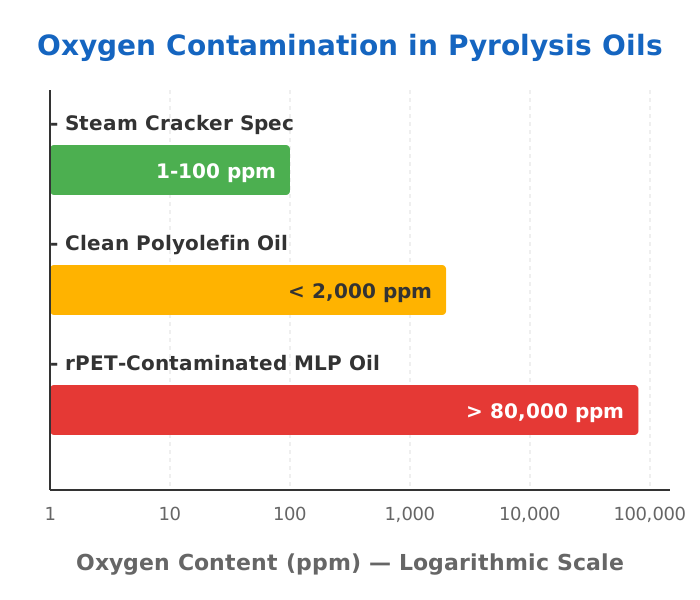
At the 80,000 ppm oxygen level associated with rPET-contaminated MLP, the resulting pyrolysis oil is approximately 800x above the 100 ppm threshold — economically impossible to upgrade to steam cracker grade through conventional pyrolysis oil purification.
Feedstock Quality Requirements for Pyrolysis
Industry guidelines confirm that pyrolysis operators require approximately 85% polyethylene and polypropylene in feedstock, with PET, EVOH, and Nylon contamination limited to 5% or less. Eunomia’s research directly challenged the widespread assumption that chemical recycling can accept all waste plastics, demonstrating that feedstock quality constraints are real and binding.
Pyrolysis Oil Purification: Necessary but Not Sufficient
Remediation technologies for contaminated pyrolysis oil exist but are prohibitively expensive at the scale of contamination created by rPET-containing MLP. BASF launched its PuriCycle catalyst portfolio specifically to remove oxygen, nitrogen, sulphur, and halogens from pyrolysis oil. Shell is building 50,000 t/year pyrolysis oil purification upgraders at Moerdijk (Netherlands) and Singapore. However, deep hydrotreatment for oxygen removal requires high hydrogen consumption, significant capital expenditure, and is viable only at scales exceeding 1,000 tonnes per day — far beyond most current chemical recycling operations globally.
The economic arithmetic is clear: it is far more cost-effective to prevent PET contamination at the packaging design stage than to attempt pyrolysis oil purification of fundamentally incompatible feedstock downstream.
Design for Recycling Guidelines: A Universal Prohibition
Every major Design for Recycling (DfR) framework globally classifies PET in polyolefin packaging as incompatible or non-recyclable:
Table 6: Global DfR frameworks unanimously classify PET in polyolefin MLP as non-recyclable
| DfR Framework | Coverage | Assessment of PET in Polyolefin MLP |
|---|---|---|
| CEFLEX (180+ European organisations) | EU flexible packaging | >5% PET classified as “not compatible” with polyolefin recycling |
| RecyClass (Plastics Recyclers Europe) | EU all packaging | PET in PE film marked red “incompatible” |
| APR (Association of Plastic Recyclers) | US/Global | PET in PE flexible packaging “renders package non-recyclable” |
The paradox is striking: recycled content mandates were designed to create circular material flows, but when applied without polymer-specificity, they produce packaging that violates the recyclability standards that these same jurisdictions are simultaneously adopting.
The Decades-Long Contamination Trajectory
The damage from polymer-agnostic mandates is not a short-term disruption — it is a structural contamination of global waste streams that will persist for decades.
Consider the timeline: rPET-contaminated MLP manufactured in India under the PWM 2022 rules enters domestic and international markets beginning FY 2025-26. This packaging has a product shelf life of 6-24 months, after which it enters the waste stream. Once in the waste stream, this MLP will be collected, baled, and shipped to recycling facilities — including pyrolysis plants — where operators expecting polyolefin-dominant feedstock will encounter increasingly oxygen-contaminated material.
With India exporting 23-25% of its FMCG production, and with Indian FMCG exports spanning Southeast Asia, the Middle East, Africa, Europe, and beyond, the contaminated MLP waste does not remain an Indian problem. Every year that polymer-agnostic mandates continue adds another cohort of non-recyclable packaging to global waste streams. The cumulative effect on pyrolysis feedstock quality and chemical recycling profitability could undermine industry viability for decades before the contaminated packaging works through the system.
The Path Forward: Polymer-Specific Regulatory Frameworks
The evidence from jurisdictions that have avoided this paradox points to clear solutions:
Immediate Measures
- Adopt polymer-specific recycled content targets. Require recycled PE in PE packaging, recycled PP in PP packaging, and recycled PET in PET packaging — as the EU PPWR and South Korea’s Resource Recycling Act have done. This single change eliminates the cross-contamination incentive entirely.
- Accelerate food-grade recycled polyolefin approval. India’s FSSAI and the UK’s FSA must establish pathways for approving mechanically or chemically recycled PE and PP for food contact applications, as WRAP’s three-year UK programme is pursuing.
Medium-Term Measures
- Implement binding Design for Recycling requirements with penalties for cross-polymer structures that violate DfR guidelines.
- Harmonise recycled content mandates with recyclability mandates to prevent the contradictory situation where compliance with one regulation violates another.
Long-Term Measures
- Develop international coordination on recycled content policy design, following the OECD’s 2024 recommendation for coherence between recycled content, food safety, and recyclability regulations.
- Invest in chemical recycling feedstock quality infrastructure — sorting technologies, near-infrared (NIR) detection of PET contamination in MLP, and polymer-specific collection streams.
Conclusion
The global drive toward recycled content mandates represents one of the most important policy developments in circular plastics. However, the evidence presented in this article demonstrates that how these mandates are designed matters as much as whether they exist. Polymer-agnostic mandates in India and the UK are structurally incentivising manufacturers to create packaging that is chemically non-recyclable — contaminating pyrolysis feedstock, undermining the economics of pyrolysis oil purification, and seeding non-recyclable waste into international markets.
The solution is not to abandon recycled content mandates but to redesign them with polymer-specificity, as the EU, South Korea, and Japan have demonstrated. Legislators must recognise that polyethylene and polypropylene are irreplaceable in multi-layered packaging for their sealing and adhesive properties, and that forcing rPET into these structures to meet polymer-agnostic targets destroys the very circularity these policies were created to achieve.
With 17 years of experience in pyrolysis technology and 49 commercial projects across global markets, APChemi has witnessed firsthand how feedstock quality determines the viability of chemical recycling. The industry cannot purify its way out of a packaging design problem. The fix must begin at the legislation.
Need help evaluating feedstock quality for your pyrolysis plant or understanding how regulatory changes affect your chemical recycling operations? Contact APChemi’s engineering team for expert consultation on feedstock sourcing, pyrolysis oil purification, and navigating the evolving regulatory landscape.